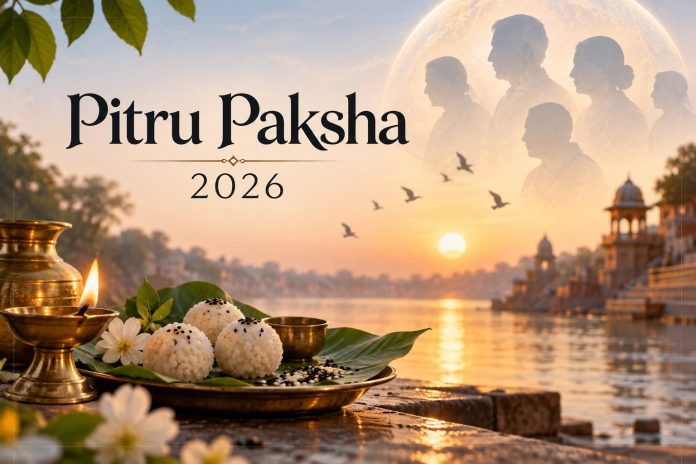
Pitru Paksha 2026: Dates Shraddh Tithi Calendar and What Pitra Dosh Really Means
Have you ever felt like you are working harder than everyone around you and still standing in the same place? Like there is an invisible weight on the family the same argument in every generation the same delay before every good thing the same illness that keeps circling back? In Vedic astrology before we look at your effort we look at what you inherited. And once a year for sixteen lunar days the tradition gives you a window to address exactly that.
Pitru Paksha 2026 runs from Saturday September 26 to Saturday October 10 ending on Sarva Pitru Amavasya the single most important day in the Hindu year for ancestral offerings. Sharad Navratri begins the very next morning on October 11 which is not a coincidence. The tradition asks you to settle accounts with the past before you step into the season of new beginnings.
This guide covers the complete shraddh tithi calendar for 2026 the actual astrology behind why this fortnight falls when it does how Pitra Dosh appears in a birth chart and the remedies that carry weight during these sixteen days. Whether you have performed shraddh every year of your life or you are the first person in your family trying to understand it you will leave this page knowing what to do and when to do it.
What Is Pitru Paksha? Understanding the Sacred Fortnight
Pitru Paksha is the waning-moon fortnight of the Bhadrapada–Ashwin period set aside for honouring the pitrs the departed ancestors of your paternal and maternal lines. It goes by many regional names. In North India you will hear Kanagat and Sorah Shraddh. In the eastern states it is Mahalaya Paksha. In Maharashtra and Gujarat simply Pitru Paksha or Pitar Paksh. The names change the observance does not.
What makes this fortnight unusual is that it has no deity at its centre. Almost every other observance in the Hindu calendar points toward a god or goddess Ganesh Chaturthi to Ganesha Navratri to Durga Diwali to Lakshmi. Pitru Paksha points backwards toward ordinary people. Your grandfather. Your great-grandmother whose name nobody remembers correctly. The uncle who died before you were born. The tradition holds that these people are not gone they are simply somewhere you cannot see and once a year the door between here and there opens a little wider.
The three core acts of the fortnight are Shraddh Tarpan and Pind Daan. Shraddh is the broader ritual the offering made with faith which is what the word literally means. Tarpan is the offering of water usually mixed with black sesame seeds barley and darbha grass poured through the fingers while facing south. Pind Daan is the offering of rice balls the most formal of the three traditionally performed at Gaya Varanasi or Prayagraj though it is done at home across most of India.
There is a reason the tone of this fortnight is restraint rather than celebration. No weddings are performed. No new houses are entered. No new businesses are launched. This is not superstition dressed up as tradition it reflects a coherent idea. You do not start something new while a debt is outstanding. You settle first then you begin. That is why Navratri opens the moment Pitru Paksha closes.
Pitru Paksha 2026 Dates: The Complete Shraddh Tithi Calendar
Pitru Paksha 2026 begins on Saturday September 26 with Purnima Shraddha and ends on Saturday October 10 with Sarva Pitru Amavasya also called Mahalaya Amavasya.
The key rule that confuses most people is this: you do not perform shraddh on the calendar date your ancestor died. You perform it on the tithi the lunar day on which they died. If your father passed away on a Panchami you observe his shraddh on the Panchami of this fortnight regardless of what the English calendar says.
| Date (2026) | Day | Tithi / Shraddha |
|---|---|---|
| 26 September | Saturday | Purnima Shraddha (fortnight begins) |
| 27 September | Sunday | Pratipada Shraddha |
| 28 September | Monday | Dwitiya Shraddha |
| 29 September | Tuesday | Tritiya Shraddha / Maha Bharani Shraddha |
| 30 September | Wednesday | Chaturthi and Panchami Shraddha |
| 1 October | Thursday | Shashthi Shraddha |
| 2 October | Friday | Saptami Shraddha |
| 3 October | Saturday | Ashtami Shraddha |
| 4 October | Sunday | Navami Shraddha (Matri Navami) |
| 5 October | Monday | Dashami Shraddha |
| 6 October | Tuesday | Ekadashi Shraddha (Indira Ekadashi) |
| 7 October | Wednesday | Dwadashi Shraddha / Magha Shraddha |
| 8 October | Thursday | Trayodashi Shraddha |
| 9 October | Friday | Chaturdashi Shraddha |
| 10 October | Saturday | Sarva Pitru Amavasya (Mahalaya) |
Three days on this list deserve special attention. Matri Navami on Sunday October 4 is dedicated to the mothers and married women of the family grandmothers mothers aunts mothers-in-law. Maha Bharani Shraddha on September 29 is considered especially powerful for those who could not perform rites at Gaya. And Sarva Pitru Amavasya on October 10 is the universal day which we will come back to.
Tithi timings shift by city sometimes by several hours and a tithi that starts late in the evening is often observed the following morning. Always confirm your specific tithi against a Panchang calculated for your own location rather than a generic national calendar.
The Astrology Behind Pitru Paksha: Why This Fortnight Why Now
Most people observe Pitru Paksha without ever being told why it falls when it does. The reasoning is elegant and once you see it the whole fortnight makes more sense.
During this period the Sun is transiting Kanya rashi Virgo. In Vedic astrology Surya is the karaka the natural significator of the father and by extension the entire paternal line. The Sun is your lineage made visible: your name your gotra the authority you inherited and the authority you will pass on. When the Sun moves through Kanya it is in a sign of service purification and analysis. Not a sign of ego and display but of quiet duty. That is precisely the posture the tradition asks you to adopt during these sixteen days.
At the same time the fortnight is Krishna Paksha the waning moon moving from Purnima toward Amavasya. The Moon governs the mind memory and emotional inheritance. As its light withdraws each night attention naturally turns inward and backward. The tradition placed the ancestral fortnight in the darkening half of the month because that is when remembering is easiest.
Then there is the ninth house the bhava of dharma father forefathers and inherited grace. When astrologers speak of ancestral karma they are usually reading the ninth house and its lord along with the Sun. And presiding over the whole conversation is Ketu the south node the graha of the past of what has already been lived of moksha and detachment. Ketu is the part of your chart that remembers things you never experienced.
Put these together and the picture is coherent. Sun in a sign of humble service Moon losing light ninth house themes active Ketu governing the territory of the departed. This is not an arbitrary date on a religious calendar. It is a window chosen because the sky supports the work.
What Is Pitra Dosh in Vedic Astrology?
Pitra Dosh is one of the most searched and most misunderstood terms in Indian astrology. Let us be precise about what it actually means because the word “dosh” has been used to frighten far too many people into far too many expensive rituals.
Pitra Dosh is not a curse. It is not punishment. In classical terms it describes an unresolved obligation in the lineage something that was left undone unpaid or unacknowledged by earlier generations which now shows up as a pattern of friction in your chart and your life. Sometimes it points to rites that were never performed. Sometimes it points to a wrong done to someone vulnerable that was never made right. Sometimes it simply points to a broken thread of continuity between generations.
In the birth chart astrologers look for a handful of recurring signatures. The clearest is affliction to the Sun by Rahu or Ketu a Surya-Rahu conjunction or the Sun placed with Ketu particularly in the ninth house. Rahu or Ketu occupying the ninth house or aspecting its lord is another classic indicator. So is the ninth lord being placed in the sixth eighth or twelfth house or the Sun sitting in one of those houses under malefic influence. Some traditions also weigh Saturn’s involvement with the Sun or the ninth house since Shani governs debt and delay.
Two cautions matter here. First none of these placements is rare. A great many charts contain one of them and a single indicator on its own means very little. Pitra Dosh is diagnosed from a pattern confirmed across the divisional charts and the running dasha not from one conjunction spotted in a free online report. Second the intensity varies enormously. The same combination that produces a mild sense of disconnection in one chart produces something far heavier in another depending on strength aspects and timing.
If you want to look at this properly in your own chart start with where your Sun sits which house Ketu occupies and the condition of your ninth lord.
How Pitra Dosh Shows Up in Everyday Life
Charts are abstract. Lives are not. Here is what the classical texts and generations of practitioners actually associate with an afflicted ancestral axis.
The most commonly cited theme is difficulty with progeny delays in conceiving repeated complications or strain in the relationship between parent and child that neither side can quite explain. The ninth house and the fifth house sit opposite each other on the axis of lineage what comes down from above affects what goes forward below.
A second theme is repetition. The same problem appearing in your father’s life your grandfather’s life and now yours. A family that loses property in every generation. A family where the eldest son and the father stop speaking in every generation. When a pattern crosses three generations without anyone consciously arranging it the tradition reads that as inherited rather than personal.
A third is the sensation of an invisible ceiling. Effort that does not convert. Opportunities that arrive and then dissolve at the last step. Recognition that goes to someone else. This is the ninth house bhagya fortune grace operating at reduced capacity. The work is being done the blessing is not landing.
Fourth is disturbance around the home and a persistent unsettled feeling sometimes accompanied by recurring dreams of departed family members. Traditional practitioners take these dreams seriously and during Pitru Paksha in particular they are read as a request rather than a warning.
Let us be realistic. Every one of these experiences has ordinary explanations too medical financial psychological structural. Vedic astrology has never claimed to be the only lens. What it offers is a second reading and a practice that has helped people carry these things for a very long time.
Shraddh Tarpan and Pind Daan: What Each Ritual Actually Does
You do not need a temple a large budget or a priest to begin. You need water sesame seeds food a south-facing direction and honest attention.
Tarpan is the simplest and the one most people can do daily through the fortnight. Rise early and bathe before eating. Face south the direction of the ancestral realm. Take water mixed with black sesame seeds and a little barley in your cupped palms and let it fall through the base of the fingers the pitru tirtha the section of the hand traditionally used for ancestral offerings rather than the fingertips used for offerings to the gods. As you pour name them. Your father your grandfather your great-grandfather your mother’s line as well. If you do not know the names say so honestly and offer to the line as a whole. Sincerity is the requirement not a complete genealogy.
Shraddh on your ancestor’s specific tithi is the fuller observance. Food is cooked traditionally including kheer rice and the seasonal preparations that person liked in life. A portion is set aside before anyone eats for the crow for the cow for the dog and for a guest. The crow in particular is regarded as the messenger of the pitrs which is why families across India still watch to see whether the offering is taken. Brahmins or in many households today anyone genuinely in need is fed. The essential act underneath all of it is simple: you cooked for someone who cannot cook for themselves.
Pind Daan is the most formal involving rice balls mixed with sesame ghee and honey offered with mantras. It is classically performed at Gaya Varanasi or Prayagraj and many families make the journey once in a lifetime on behalf of the whole line. It can be performed at home under guidance and during Pitru Paksha many temples arrange collective ceremonies.
One question comes up constantly: what if you do not know the tithi of death or do not know when an ancestor died at all? The tradition answers this directly and it is the reason Sarva Pitru Amavasya exists.
Pitra Dosh Remedies for Pitru Paksha 2026
Shraddh tarpan and pind daan performed sincerely during this fortnight are held to carry more weight than the same acts performed at any other time of year. That is the entire logic of Pitru Paksha as a remedial window. Here is what the tradition emphasises framed as traditional practice rather than as any guarantee of outcome.
Daily tarpan through all sixteen days done in the morning before eating is the foundation. If you do nothing else do this. Consistency across the fortnight matters more than elaborateness on any single day.
Feeding is the second pillar and arguably the one most emphasised in the classical sources. Feed the poor feed the elderly feed anyone unable to feed themselves. Feed cows crows and stray dogs. Annadaan the giving of food is considered the highest form of charity during this period specifically because the ancestors are said to be received through it. If your schedule allows nothing else arrange one meal distribution during the fortnight.
Recitation and worship follow. The Pitru Stotra Pitru Gayatri and the Garuda Purana are the traditional texts for this fortnight. Many households recite the Bhagavad Gita’s second chapter on the imperishable nature of the self. Those working specifically with an afflicted Sun often add Aditya Hridaya Stotra or the Surya Gayatri at sunrise and offer arghya water poured toward the rising Sun from a copper vessel with a little roli and red flowers.
Where Ketu is strongly implicated lighting a lamp with sesame oil on Amavasya and offering blankets black sesame or iron to those in need are the traditional supports. Peepal tree worship also belongs here. Water is offered at the roots of a peepal in the morning and a lamp lit beneath it in the evening since the tree is regarded as a dwelling place of ancestors.
The most overlooked remedy is the least ritual one. Repair the living relationships in your family. Call the relative you stopped speaking to. Take care of the elderly people you have been avoiding. Return what was borrowed. Classical astrology treats Pitra Dosh as an unpaid debt of the lineage and a debt in the lineage is very often paid in the present tense by the living to the living. No amount of ritual substitutes for that.
Please be cautious with anyone who diagnoses Pitra Dosh in five minutes and prescribes an expensive ceremony as the only cure. A genuine reading takes the whole chart the divisional charts and the running dasha into account.
What to Avoid During Pitru Paksha 2026
The restraint of this fortnight is as meaningful as the offerings. New beginnings are traditionally postponed until after October 10 weddings engagements griha pravesh vehicle purchases business launches and formal starts of any kind. Gold new clothes and major purchases are generally deferred. Many households avoid non-vegetarian food onion garlic and alcohol for the full sixteen days and haircuts shaving and nail-cutting are avoided by those performing shraddh.
None of this is meant to make the fortnight gloomy. Restraint here is a form of attention. You are clearing space rather than punishing yourself and everything you postponed becomes available again the moment Navratri opens on October 11 which is by design one of the most auspicious stretches of the entire year for exactly the things you set aside.
Anyone who arrives at your door during Pitru Paksha should be fed. The tradition holds that ancestors may come in unrecognised form and that turning away a guest during this fortnight undoes the offerings made in it.
Sarva Pitru Amavasya October 10: The Most Important Day
If you observe only one day of Pitru Paksha 2026 observe Saturday October 10.
Sarva Pitru Amavasya also called Mahalaya Amavasya is the universal day. It covers every ancestor whose tithi you do not know whose date of death was never recorded who died away from home who died without rites or whom nobody in the family remembers by name. It also covers the ancestors whose specific tithi you missed during the fortnight. Sarva means all and the day means what it says.
There is a further reason this particular Amavasya carries so much weight. It is the new moon Sun and Moon in the same degree and it falls with the Sun still in the sign of service. Both luminaries the significators of father and mother stand together in darkness. In the entire year there is no configuration more precisely suited to the work of remembering.
Rise before sunrise. Bathe. Offer arghya to the Sun. Perform tarpan for the whole lineage paternal and maternal named and unnamed. Cook a proper meal and set aside portions for the crow the cow the dog and the guest before anyone in the household eats. Feed at least one person who needs it. Light a sesame-oil lamp at dusk facing south. Say thank you out loud to people you may never have met.
The next morning Navratri begins.
Frequently Asked Questions
When is Pitru Paksha 2026? Pitru Paksha 2026 runs from Saturday September 26 to Saturday October 10 beginning with Purnima Shraddha and ending on Sarva Pitru Amavasya.
What if I don’t know my ancestor’s death tithi? Perform the rites on Sarva Pitru Amavasya October 10 2026. That day exists precisely for ancestors whose tithi is unknown or was missed.
Can women perform shraddh? Traditionally the eldest son performs the rites but classical sources and modern practice both permit daughters wives and other family members where no son is available or willing. Many practitioners hold that the offering made with faith is valid regardless of who makes it.
Is Pitra Dosh permanent? No. It is treated as a debt rather than a sentence something that can be addressed through sustained observance charity and repair of living family relationships. Its intensity also varies with the running dasha so it is not equally active throughout life.
Can I do tarpan at home without a priest? Yes. Daily tarpan with water and black sesame performed facing south before eating is done at home across India without priestly assistance.
Why can’t we start new things during Pitru Paksha? The fortnight is understood as a period of settlement rather than initiation. New beginnings resume with Sharad Navratri from October 11 2026.
Conclusion
Pitru Paksha asks something unusual of us. Not devotion to a god not a request for prosperity but sixteen days of remembering people who cannot thank us for it.
If there is genuine Pitra Dosh in your chart this fortnight is the most supported window in the year to address it and it is worth preparing for rather than dreading. If there is not the fortnight still asks you to look backwards with some honesty at where you came from what was handed to you and what you are handing forward. Very few of us do that work voluntarily.
You have from September 26 to October 10 2026. Sixteen days. Water sesame seeds food for someone hungry and the names of people who made your life possible. That is the whole practice.
Then on October 11 the lamps come out and Navratri begins and you walk into it with the past settled behind you.

