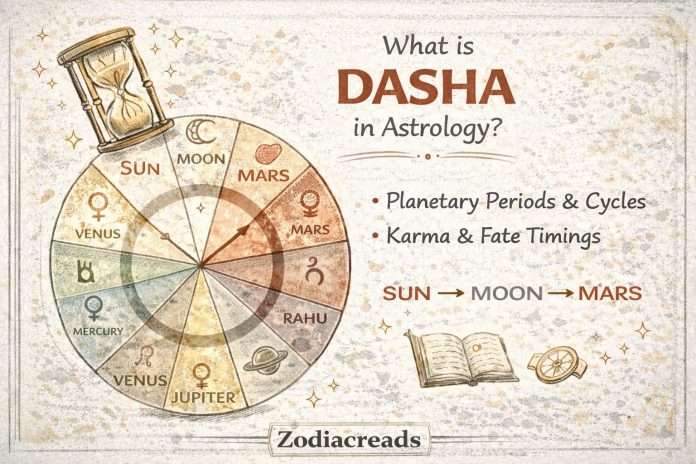
What Is Dasha in Astrology? A Simple Guide to Timing Events in Life
In Vedic astrology, planets show what can happen in life, but Dasha shows when it will happen. This is why Dasha is one of the most important tools in astrology. Two people can have similar birth charts, but their lives turn out very differently because their Dashas operate at different times.
If you’ve ever wondered why life suddenly improves, why struggles come in phases, or why some efforts succeed only during certain periods, the answer often lies in Dasha.
This article explains what Dasha is, how it works, why it matters more than single planet placements, and how to understand it in a simple, practical way.
What Does “Dasha” Mean in Astrology?
The word Dasha comes from Sanskrit and means “state,” “condition,” or “period.”
In astrology, Dasha refers to a planetary time period during which a specific planet becomes active and gives results based on its position in your birth chart.
Every person goes through different Dashas throughout life. Each Dasha activates different themes, such as career growth, marriage, money, health, or spiritual change.
In simple words:
Dasha = the timing system of life events
Why Dasha Is So Important in Vedic Astrology
Many beginners focus only on where planets are placed, like “Saturn in 7th house” or “Jupiter in 9th house.” But planets do not give full results all the time.
A planet gives its strongest results only when its Dasha or sub-period is running.
That’s why:
- A good planet may not give benefits immediately
- A difficult placement may not cause problems right away
- Life changes suddenly when Dasha changes
Dasha explains why things happen in phases, not all at once.
What Is Vimshottari Dasha?
There are many Dasha systems in Vedic astrology, but the most widely used and trusted one is Vimshottari Dasha.
“Vimshottari” means 120 years, which is considered the maximum human lifespan in astrology. This system divides life into planetary periods totaling 120 years.
The Vimshottari Dasha sequence always follows this fixed order:
Ketu – 7 years
Venus – 20 years
Sun – 6 years
Moon – 10 years
Mars – 7 years
Rahu – 18 years
Jupiter – 16 years
Saturn – 19 years
Mercury – 17 years
After Mercury, the cycle repeats again with Ketu.
How Is Your Starting Dasha Decided?
Your Moon’s Nakshatra at birth decides:
- which Mahadasha you start with
- how much of that Dasha is remaining at birth
This is why Moon is extremely important in Vedic astrology. Even if two people are born on the same day, a slight difference in Moon degree can change their starting Dasha.
Types of Dasha Periods
Dasha works in layers. The deeper you go, the more precise the timing becomes.
1) Mahadasha (Major Period)
This is the main ruling planet for a long phase of life (6 to 20 years).
It sets the overall theme of that period.
Example:
- Venus Mahadasha → relationships, comfort, career growth, luxury
- Saturn Mahadasha → responsibility, struggle, discipline, long-term building
2) Antardasha (Sub-period)
Within each Mahadasha, there are smaller periods ruled by other planets.
Antardasha shows how the Mahadasha plays out.
Example:
- Venus–Saturn → career pressure in relationships
- Venus–Jupiter → growth, learning, financial improvement
3) Pratyantardasha (Sub-sub period)
This fine-tunes results further and explains short-term events, like:
- job changes
- marriage proposals
- sudden stress or relief
Why Dasha Matters More Than Planet Placement Alone
A planet can be strong in the chart but still give weak results if its Dasha is not active.
For example:
- Jupiter in a good house may not give luck until Jupiter Dasha runs
- Saturn in 7th may not delay marriage until Saturn becomes active
- Rahu in 2nd may not disturb finances until Rahu period starts
This is why astrologers always check:
Chart + Dasha + Transits
Never chart alone.
What Does a Planet Give During Its Dasha?
A planet gives results based on:
- the houses it owns
- the house it is placed in
- its strength or weakness
- conjunctions and aspects
- support or affliction from other planets
Example:
If Venus rules good houses and is well placed, Venus Dasha can give:
- career growth
- relationship opportunities
- comfort and money
If Venus is weak or afflicted, the same Dasha may give:
- emotional confusion
- relationship stress
- financial imbalance
So Dasha does not act blindly. It activates what is already promised in the chart.
Why Life Feels Unstable Without Understanding Dasha
Many people feel confused because:
- “Earlier life was fine, now everything is difficult”
- “I am working hard but results stopped”
- “Why did things suddenly improve?”
These shifts often happen when:
- a challenging Dasha begins
- a supportive Dasha ends
- a sub-period changes
Dasha explains why effort alone does not control timing.
Dasha and Major Life Events
Most big events happen during specific Dashas:
Marriage often happens in:
- 7th lord Dasha
- Venus Dasha
- supportive Jupiter periods
Career rise often happens in:
- 10th lord Dasha
- Sun, Saturn, Mercury periods
- Financial growth often happens in:
Jupiter, Venus, Mercury, Rahu Dashas
Spiritual shifts often happen in:
- Ketu Dasha
- Saturn Dasha
- 12th house connections
- Dasha shows when a door opens.
Common Mistakes People Make About Dasha
1) Thinking One Dasha Is Always Good or Bad
No planet is fully good or bad. Results depend on chart placement.
2) Ignoring Sub-periods
Many people panic about Mahadasha without checking Antardasha, which often changes the experience completely.
3) Expecting Instant Results
Some Dashas work slowly, especially Saturn and Jupiter. They reward patience.
4) Not Combining Dasha With Transits
Dasha shows timing, transits act as triggers.
How to Use Dasha in a Practical Way
You don’t need to predict exact dates to benefit from Dasha knowledge.
You can use it to:
- understand why life feels slow or fast
- avoid risky decisions in unstable periods
- plan education, career, or investments
- work with time instead of fighting it
Awareness itself reduces stress.
Final Thoughts: Why Dasha Is the Heart of Astrology
If astrology is a map, Dasha is the clock.
Planets show potential.
Dashas decide activation.
Time decides experience.
Understanding Dasha helps you stop blaming yourself for delays and start aligning with life’s rhythm. It teaches patience, awareness, and smart decision-making.
In Vedic astrology, wisdom is not just knowing what will happen it is knowing when to act and when to wait.

