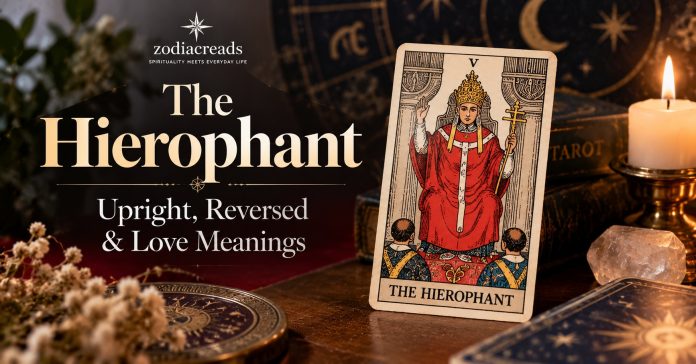
The Hierophant tarot: upright, reversed & love meanings
The Hierophant tarot appears when a reading leans toward structure, shared belief and formal teaching. In many decks the Hierophant points to institutions, rites, and the codes people follow together, so the card is often read as a signpost toward communal frameworks rather than private rebellion.
A.E. Waite’s Pictorial Key to the Tarot shaped how most modern readers see the Hierophant. The RiderWaiteSmith imagery, the robed figure, the two acolytes, the hand gesture of blessing, made the card a shorthand for teachers, organized religion and handeddown wisdom. That visual tradition still guides a lot of contemporary interpretation.
Remember, the Hierophant inclines readings toward collective structure it does not dictate what will happen. The card tends to suggest probabilities and roles, think mentorship, ceremony, or institution, and you read those tendencies against the question and the querent’s life circumstances.
What the Hierophant represents
Core themes with the Hierophant are tradition, institutions, teachers and shared values. In practice the card tends to point at formal systems that transmit knowledge: schools, churches, guilds, apprenticeship lines and cultural rituals.
A.E. Waite’s Pictorial Key to the Tarot is the goto source for how the Hierophant is pictured and named in most Englishlanguage decks. The RiderWaiteSmith imagery established the visual language many readers still rely on, so features like the throne, the triple crown and the two followers shape the card’s modern meaning as a teacher or institutional figure.
Classically, readers influenced by 19th–20th century occultists have emphasized continuity and orthodoxy when the Hierophant shows up. That tradition reads the card as favoring collective norms and formal rites more than individual rebellion or radical change.
Keep the hedging clear. The Hierophant inclines toward communal answers it does not decide them. Use the card as a pointer to which systems matter in the querent’s life rather than as a final ruling on what they must do.
Upright meaning: themes and tendencies
Common upright readings include mentorship, ritual, formal commitment and moral or spiritual guidance. The card classically signals someone or something that provides structure: a teacher, a clergy member, a professional body or an established procedure.
In work readings the Hierophant tends to show a formal path, certification, a steady employer, or mentorship that helps you climb. Family queries often point to established roles, family traditions or weddings and rites of passage. For study, the card leans toward structured learning, accredited courses and tutors rather than DIY approaches. In community contexts it usually suggests institutions, clubs or organized volunteer bodies offering clear rules.
Traditional tarot schools influenced by 19th–20th century occultists read the upright Hierophant as a guardian of collective wisdom and custom. Those sources often link the card to ethical conservatism and the transmission of doctrine.
Practical note: in a career spread the Hierophant upright tends to encourage formal channels, registrations, HR processes, professional mentorship. In a spiritual spread, the same card more often points to a teacher, a lineage or ritual practice that helps stabilize belief. Read context first, then let the card tilt your interpretation.
Reversed meaning: what it tends to indicate
Reversed Hierophant tendencies include questioning tradition, nonconformity, dogma misused and the breakdown of internalized rules. The reversal often signals that the structures the querent relied on are being challenged or are no longer serving them.
Offer shades rather than a single verdict. Maybe the reversal is healthy dissent, choosing a different path from family or faith. Or it can point to dogma being weaponized, where an institution enforces rules unfairly. Sometimes it’s an internal shift: the querent loosens selfimposed restrictions learned from authority figures.
Remember that reversed cards can soften an upright message instead of simply meaning ‘bad.’ The Hierophant reversed might mean the same themes, teachers, rules, institutions, are present but altered: less rigid, more personal, or in need of reform.
Examples: in a relationship reading a reversed Hierophant can show old household rules feeling restrictive, so partners are renegotiating expectations. In a workplace question it can indicate a mentor who no longer fits their role or a company culture that no longer aligns with the querent’s values.
The Hierophant in love and relationships
Upright, the Hierophant tends to suggest conventional partnerships, commitments, or shared values and rituals. In a relationship reading the card classically reads as marriage, formal commitment, or joining a community that supports the couple. Think ceremonies, family expectations, and agreedupon roles rather than sudden passion.
Reversed, the Hierophant often points to unconventional arrangements, friction over expectations, or a desire to rewrite the rules of partnership. It can show one or both partners questioning inherited patterns, resisting tradition, or finding that dogma and etiquette are blocking honest connection. That tension doesn’t automatically mean breakup it tends to mark a moment when norms are being tested.
Where the Hierophant sits in the spread changes the tone. In a supporting position, such as advice or outcome, an upright Hierophant tends to recommend leaning into structure: shared rituals, counseling from a respected elder, or a clear commitment. In a challenging position, the same upright card can highlight pressure from family or a relationship becoming too rigid.
If reversed in a supportive slot, the card often reads as permission to deviate from expectation: choose a nontraditional timetable, make your own rules. Reversed in a challenge position tends to flag stubbornness, hidden resentment about roles, or power struggles over who gets to set the rules.
Before you settle on upright or reversed meanings, ask targeted questions. Are your querent’s concerns about external rules or internal needs? Who benefits from keeping routines the way they are? Is there a shared language and ritual already in the relationship, or are partners improvising? Also check timing: is this a longstanding pattern or a recent shift?
Small reading tip, practical and plainspoken. If the querent mentions family pressure right away, weight the upright Hierophant toward external expectation. If they talk about wanting something different from their upbringing, prioritize reversed meanings. Use the querent’s examples of concrete rituals, weddings, living arrangements, religious practices, as anchors when choosing which reading fits best.
Quick howto: reading the Hierophant in a spread
Placement matters. In the past position the Hierophant tends to point to formative traditions, a mentor relationship, or rules you grew up with. In the present it highlights current structures, institutions, or a call to follow or question a code. In the challenge slot it flags where conformity or rebellion is actively blocking progress. In advice it usually suggests either seek guidance from a trusted teacher (upright) or invent a new way forward (reversed).
Pairings change nuance. With Major Arcana the Hierophant often reads as a longterm theme: combined with the Lovers it highlights value alignment with the Tower it can mark a clash between tradition and upheaval. With court cards and suits the card sharpens into everyday behavior: paired with a King or Queen it may indicate parental influence or authority with swords suits it tends to show arguments about rules with cups it can show shared ritual in an emotional context.
Twocard combos to keep on hand. Hierophant plus Two of Cups tends to suggest committed partnership shaped by shared values or a formalizing step. Hierophant plus Five of Pentacles often points to feeling excluded by a community or punished by strict norms. Hierophant plus The Fool can indicate choosing a radically new path away from inherited structures. Each combo leans, it doesn’t decree ask which details the querent recognizes.
Practical phrasing to use in a reading. Say things that leave room for choice and detail, for example: “This card tends to show established rules or a mentor in your situation, does that fit what you’re facing?” or “I’m seeing either an invitation to follow a known path or permission to rewrite it. Which sounds truer right now?” For reversed contexts try: “This often points to tension over expectations, where are you pushing back?” These lines keep the interpretation open and rooted in the querent’s experience.
Common mistakes and how to avoid them
Treat the Hierophant as guidance, not a command. The Hierophant tends to describe structures, traditions and the social context around a question. Readers often mistake that for an instruction, “do X now”, but classical sources read the card as influence, not destiny.
Don’t manufacture threats or miracles to make the card dramatic. Saying the Hierophant “fixes” a broken relationship or “dooms” a career overstates what a card classically represents. That kind of framing invents problems you didn’t have and sells a false certainty.
If you use literal religious language, name your source. Lots of interpretations borrow from Catholic, Vedic or esoteric texts. Be specific: cite a tradition or text when you claim the card maps to a concrete ritual or doctrine.
Keep phrasing cautious and documentable. Use verbs like “tends to”, “is associated with” or “classically read as.” That keeps the reading useful without presenting it as absolute truth.
- Checklist for precision: note your source (RiderWaite, Marseille, a named text).
- State the tendency (e.g., leans toward conformity, mentorship, institutional support).
- Offer clear alternatives (structured guidance vs. private conscience formal counsel vs. personal ethics).
- Avoid miracle or horror framing don’t invent problems to sell solutions.
Rituals, symbols and crosstradition notes
The card’s key symbols point to its typical readings. Two crossed keys under the Hierophant classically signify access and authority, often read as gatekeeping or the ability to translate secret knowledge. The staff or scepter suggests institutional power and ordained office. The triple cross, found in many RiderWaitederived decks, tends to signal layered spiritual authority, public, private and esoteric levels of belief.
Different traditions treat those symbols differently. In the Marseille tradition the figure looks more like a pope in formal robes and the emphasis is on social office and ceremony, so readings lean toward community norms and public roles. RiderWaiteSmith adds richer iconography, like the two acolytes, and tends to be read as mentorship, teaching and the passing of doctrine. Noting which deck you’re using helps your reader understand which emphasis you mean.
If you include a ritual, make it optional and modest. For example, you might suggest journaling about a mentor figure for 10 minutes before a reading, or lighting a candle to mark an intention to consult tradition. Phrase it as a personal tool, not a corrective: “Some people find this clarifies what the Hierophant is pointing at for them.” Don’t claim the ritual alters fate or guarantees outcomes.
- Symbols to note: keys (access/authority), staff (institutional power), triple cross (layered spiritual authority).
- Marseille vs RiderWaite: Marseille emphasizes public office and ceremony RiderWaite emphasizes teaching and counsel.
- Ritual note: optional journaling or a brief candle practice, described as a personal aid only.
Keep the Hierophant precise and humble in your reading: name the deck or tradition, state the tendency you see, and offer alternatives rather than orders.
That approach makes the card more useful. It helps the querent weigh institutional advice against private conscience, without ever pretending the tarot decides for them.
Frequently asked questions
Is the Hierophant a good card in love readings?
It tends to indicate stability and shared values when upright, and rulebreaking or mismatched expectations when reversed neither reading is inherently ‘good’ or ‘bad’.
How should I interpret the Hierophant reversed?
Read it as a tendency toward questioning tradition or authority check surrounding cards and the querent’s situation before settling on a single meaning.
Can the Hierophant mean a specific person?
Sometimes readers associate the Hierophant with teachers, mentors or structured elders, but identifying a specific person depends on the spread and corroborating cards.
Should I use rituals to ‘appease’ the Hierophant?
Rituals can help clients articulate intentions, but the card itself doesn’t demand remedies never present ritual as the only solution to a problem the reading invented.
What pairs well with the Hierophant in a relationship spread?
Cards that highlight commitment like the Lovers or practical suits like Pentacles tend to clarify whether the Hierophant’s structure is supportive or constraining.

