Have you ever felt a sudden urge to just drop everything and walk away? Maybe you’ve experienced a strange sense of dissatisfaction even when you achieved something you thought you desperately wanted. Or perhaps you have that one area in life where, no matter how hard you try, things just feel… empty. Like there’s a missing piece you can’t quite put your finger on.
If any of this sounds familiar, you’re likely feeling the ghostly touch of Ketu.
In the vast, intricate world of Vedic astrology, most planets are busy adding things to your life. Jupiter wants to give you wisdom and expansion; Venus wants to shower you with love and luxury. But Ketu? Ketu is the odd one out. It’s the minimalist of the zodiac. It’s not interested in what you can gain; it’s interested in what you’re ready to lose.
For many people beginning their astrology journey, Ketu is scary. It’s often painted as a villain, a malefic force that causes confusion and loss. But that’s a massive oversimplification. To truly understand your birth chart, you have to make friends with this shadow planet. Ketu isn’t trying to ruin your life; it’s trying to wake you up. It’s the cosmic force of liberation, past-life karma, and spiritual evolution. Let’s dive deep into the smoky, mysterious world of the South Node and figure out what it’s actually doing in your horoscope.
The Headless Body: Understanding the Basics of Ketu
Before we get into predictions and house placements, we need to understand the mythology and the core energy. You can’t analyze a planet if you don’t know its personality, right?
The Myth of the Dragon’s Tail
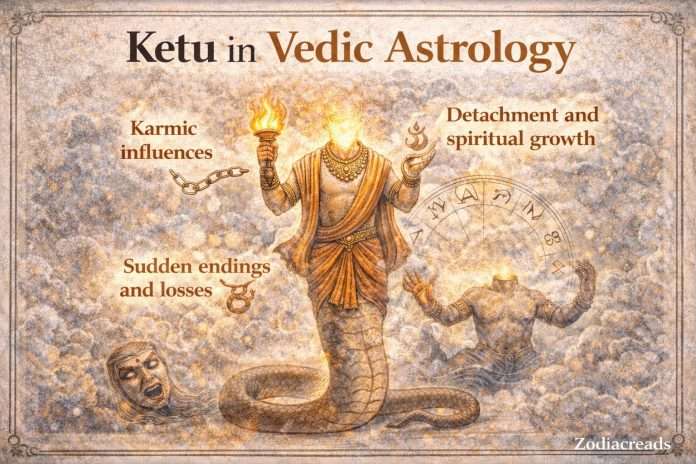
In Indian mythology, the story of Rahu and Ketu is pretty dramatic. It involves the churning of the cosmic ocean (Samudra Manthan) to obtain the nectar of immortality. A demon named Swarbhanu managed to sneak in and drink a drop of this nectar. The Sun and Moon spotted him and snitched to Lord Vishnu, who promptly used his discus to cut off the demon’s head.
But here’s the catch—he had already swallowed the nectar. He couldn’t die. So, the head became Rahu, and the headless body became Ketu. This imagery is crucial. Rahu has a head but no stomach; he’s obsessed with consuming but never satisfied. Ketu has a body but no head; he has no senses, no logic, no eyes to see the material world. He operates on pure instinct, intuition, and internalized energy.
The “Shadow Planet” Concept
Technically speaking, Ketu isn’t a physical planet like Mars or Saturn. You can’t point a telescope at the sky and see a rock called Ketu. It is a mathematical point—specifically, the South Node of the Moon. It’s one of the two points where the Moon’s orbit intersects with the ecliptic (the path of the Sun). This is why Rahu and Ketu are responsible for eclipses. They are “Chaya Grahas” or shadow planets. They have the power to swallow the luminaries (Sun and Moon), meaning they can overshadow our soul and our mind.
Because it’s a shadow, Ketu works on the psychological and subconscious levels. It’s hard to grasp because it deals with things that aren’t tangible. It rules over things like:
- Detachment and isolation
- Spiritual enlightenment (Moksha)
- Past life skills and accumulated karma
- Confusion and lack of clarity
- Intuition and psychic abilities
- Viruses, deep research, and coding (the invisible structures)
Past Life Mastery
This is my favorite way to explain Ketu. Think of Ketu as a bucket that is already full. The house where Ketu sits in your chart represents an area of life you have mastered in previous incarnations. You’ve been there, done that, and bought the t-shirt. Because you’ve done it so much, you’re naturally good at it in this life—but you also don’t really care about it. You’re subconsciously bored with it.
For example, if you have Ketu in the 2nd house of money, you might have been very wealthy in a past life. In this life, you might have the ability to make money easily, but you don’t derive deep satisfaction from it. You might even walk away from a high-paying job because it feels meaningless. That’s Ketu saying, “Next chapter, please.”
Ketu in Action: Main Effects and Influences
So, how does this headless, spiritual, detached energy actually show up in your day-to-day life? It’s a mix of brilliance and frustration. Ketu acts like a black hole—it sucks the material attachment out of whatever house it sits in, leaving only the spiritual essence.
The Energy of “Letting Go”
Wherever Ketu is placed, you will experience a weird phenomenon: the more you chase it, the more it runs away. But the moment you let go, it comes to you.
Let’s look at relationships. If Ketu is in your 7th house (the house of marriage and partnership), you might desperately want a connection. But every time you try to grip a relationship tightly, it dissolves like smoke. You might attract partners who are emotionally unavailable, spiritual, or just… distant. Ketu is teaching you that your fulfillment cannot come from another person. Once you stop obsessing over relationships and focus on yourself, suddenly, a partner appears. But by then, you’re detached enough that you handle the relationship with a cool, calm maturity rather than needy desperation.
Ketu and Career: The Researcher and The Mystic
Ketu isn’t just about monks sitting in caves. In the modern world, Ketu rules deep research, coding, languages, and investigation. Why? Because Ketu digs deep. It wants to get to the root of things, the invisible layer.
People with strong Ketu influence (like Ketu in the 10th house or conjunct the 10th lord) often make incredible programmers, surgeons (cutting things open to fix them), investigators, and astrologers. They see patterns that others miss because they aren’t distracted by the surface-level glitter. They don’t care about the office politics or the fancy job title; they just want to solve the puzzle.
The Flag of Reputation
There’s an old saying in Vedic texts that “Ketu is the Flag.” A flag sits on top of a temple or a castle—it’s high up and visible. Paradoxically, while Ketu represents isolation, it can also bring massive fame. But it’s a specific kind of fame.
Usually, Ketu brings recognition for something you didn’t intentionally try to be famous for. You might be quietly working on a project in your basement for ten years because you love it, and suddenly, the world discovers it and calls you a genius. You stand on the stage accepting the award, feeling slightly awkward and thinking, “I just wanted to do my work.” That is the Ketu glory—success that comes when you detach from the outcome.
The Emotional Rollercoaster
On the flip side, a badly placed Ketu can cause intense anxiety. Since Ketu has no head, it can lead to headless behavior—acting without thinking, sudden bursts of anger (since it is fiery like Mars), or deep, inexplicable depression. It can make you feel like you don’t belong in this world.
It creates a sense of separation. If Ketu is in the 4th house (mother and home), you might feel like a stranger in your own house, or have a distant relationship with your mother, even if you live under the same roof. It creates a psychological wall that is hard to break down.
Special Considerations: Nuances You Can’t Ignore
Astrology isn’t one-size-fits-all. You can’t just say “Ketu is bad” or “Ketu is spiritual.” It depends heavily on who Ketu is hanging out with.
The Ketu-Moon Conjunction (Grahan Yoga)
This is a big one. When Ketu sits with the Moon, it influences the mind deeply. The Moon is your emotions, and Ketu is detachment. This person often has a very deep, intuitive mind but struggles with emotional connection. They can be incredibly psychic or incredibly anxious. They tend to over-analyze their own feelings until they feel numb. It’s a powerful placement for spiritual seekers but challenging for domestic happiness.
Ketu-Jupiter: The Guru’s Touch
When Ketu combines with Jupiter, it’s magic for spirituality. Jupiter is traditional wisdom, and Ketu is the flag of Moksha. Together, they create the “Ganesha Yoga.” This combination often produces wise teachers, natural healers, and people who have a very mature outlook on life from a young age. Their wisdom doesn’t come from books; it comes from intuition.
Ketu Maturity Age
Did you know planets have maturity ages? Ketu matures around age 48. Before this age, the confusion of Ketu is often more prominent. You might struggle to understand why you feel detached or dissatisfied. But once you hit your late 40s, the fog clears. You start to understand the spiritual purpose behind your losses. You stop fighting the detachment and start embracing the freedom it brings.
Sign Placement Matters
Ketu acts very differently in different signs. In Scorpio (a sign it co-rules), it is intense, researching, and transformative. In Pisces, it is dreamy and incredibly spiritual—it feels at home there. But in a sign like Taurus, which is all about material comfort and stability, Ketu is uncomfortable. It creates a constant tug-of-war between wanting security and wanting to run away to the mountains.
Remedies and Solutions: Making Peace with the Shadow
If Ketu is causing havoc in your chart—making you feel isolated, confused, or physically weak—don’t panic. Vedic astrology is never about doom and gloom; it’s about management.
Worship of Ganesha
The primary deity associated with Ketu is Lord Ganesha. Think about it: Ganesha has the head of an elephant on a human body, and Ketu is a headless body. Ganesha provides the intelligence and direction that headless Ketu lacks. Chanting Ganesha mantras or simply praying to him helps ground Ketu’s erratic energy and removes obstacles.
Embrace Dogs
This is a classic remedy. In the Vedic tradition, dogs are associated with Ketu. Feeding street dogs or taking care of a pet dog is considered one of the best ways to pacify malefic Ketu. It teaches unconditional love and loyalty, grounding the wandering energy of the South Node.
Gemstone Therapy: Cat’s Eye
The gemstone for Ketu is the Cat’s Eye (Lehsunia). It creates a very sharp, protective energy. However, a word of caution: Do not wear this stone without consulting an astrologer. Because Ketu is explosive and unpredictable, wearing a Cat’s Eye when Ketu is badly placed can actually increase anxiety or cause sudden injuries. It’s a powerful tool, not a fashion accessory.
The Spiritual Solution
Ultimately, the best remedy for Ketu is to give it what it wants: spiritual awareness. Meditation is non-negotiable for Ketu people. You need a daily practice where you disconnect from the material world. If you don’t voluntarily disconnect (through meditation), Ketu will force you to disconnect (through isolation or loss). Choose the voluntary path—it’s much more pleasant.
Conclusion: The Gift of Liberation
Ketu is complex. It’s the monk, the psychic, the hacker, and the ghost. It brings confusion, yes, but it also brings the ultimate clarity that lies beyond the material world.
If you are in a Ketu dasha (planetary period) or have a prominent Ketu in your chart, don’t look at it as a curse. Look at it as a cosmic decluttering. Ketu is clearing out the junk—the bad relationships, the meaningless jobs, the false ego—so that you can see who you really are. It asks you to trust your intuition over your logic and to value inner peace over outer validation.
So, the next time you feel that urge to retreat and find yourself, listen to it. That’s Ketu guiding you toward your highest truth. Embrace the mystery, feed a dog, mediate a little, and watch how the chaos transforms into wisdom.
Curious about where Ketu sits in your own chart? Check your horoscope or consult with an astrologer to see exactly which area of your life is ripe for liberation.

